
Semiconductor measurement,
made accessible
Students measure the I-V characteristics of diodes and transistors themselves. Built by a physics faculty member to solve a problem encountered in his own teaching lab.
Measures the devices AI is made of.
Takes its orders from your agent.
Both halves are meant literally. Otter I-V Expert ships with routines for memristors and synaptic devices, and the same instrument runs headless from a command line, so an agent can take the measurement rather than hand you a script to run.
Let your agent run the machine.
The devices
Memristor endurance and retention, synaptic EPSC / PPF, potentiation and depression. Arbitrary pulse trains are read from a file, which is what physical reservoir computing needs.
One executable, two modes
The same binary opens a window, or runs a measurement with no window at all. Nine measurements, one JSON object on stdout, and an exit status a caller can branch on.
Paste the manual in
The command manual is written to be handed to an AI assistant whole. Its command list is generated from the firmware, so it cannot drift from what the instrument actually answers.
A measurement taken from the command line and one taken by clicking Run go through the same code: the same compliance limit, the same range selection, the same settling delay, the same output-off at the end. What the instrument does not do is interpret the result. That part is yours.
Two instruments, two settings
Otter I-V for the undergraduate teaching lab, Otter I-V Expert for the research bench.
Teaching lab
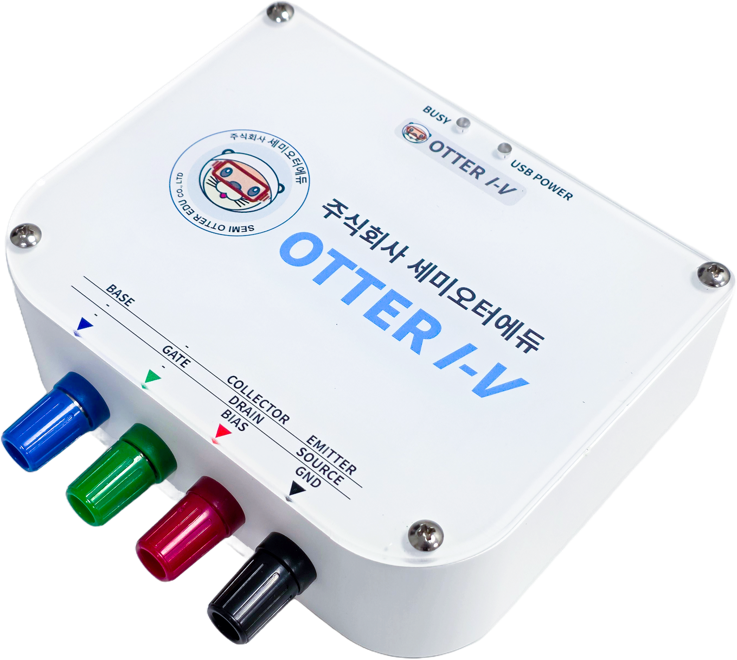
Otter I-V
A single USB connection drives five measurement modes, from diodes through to transistors. Lab handouts are supplied with the instrument.
 Research
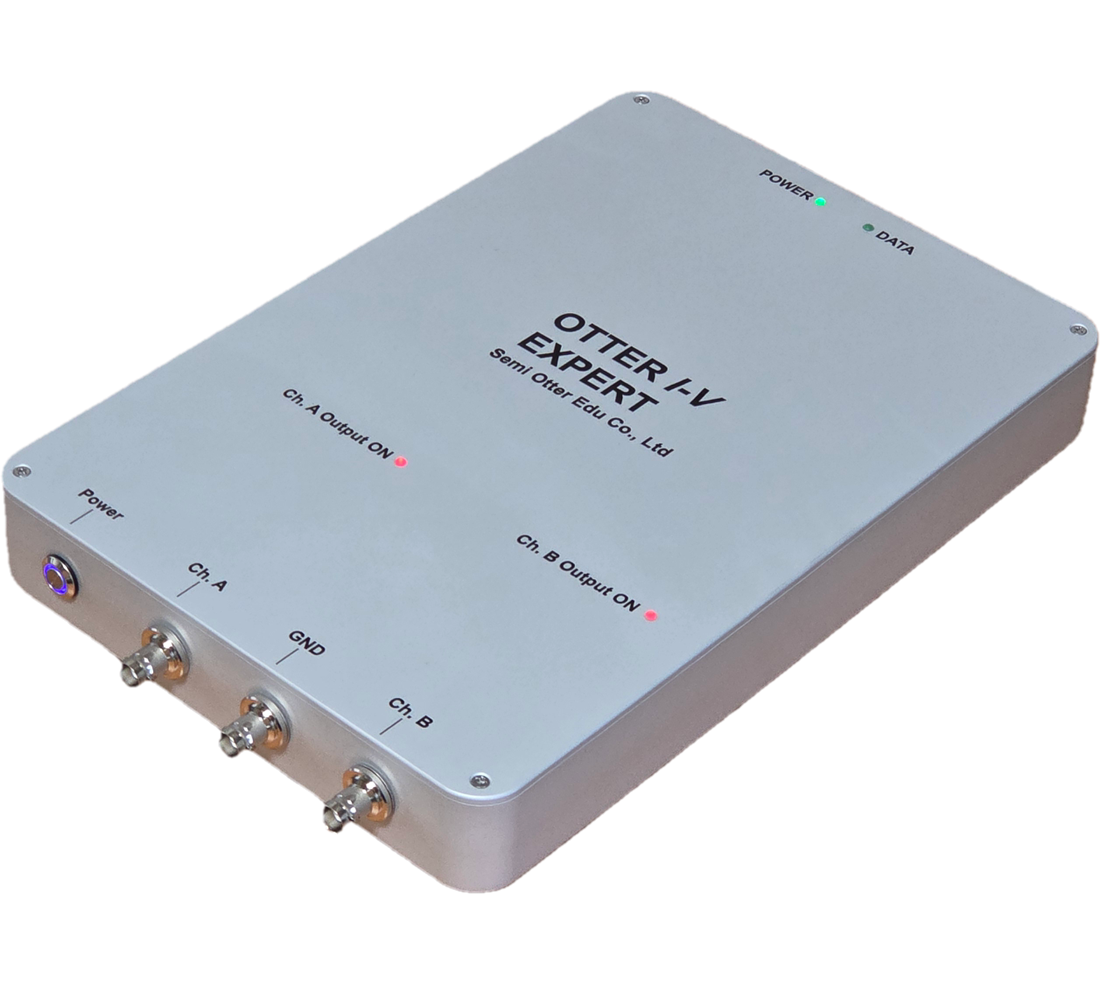
Otter I-V Expert
Two channels at ±80 V each, with built-in routines for memristors and synaptic devices.
A laptop and a breadboard
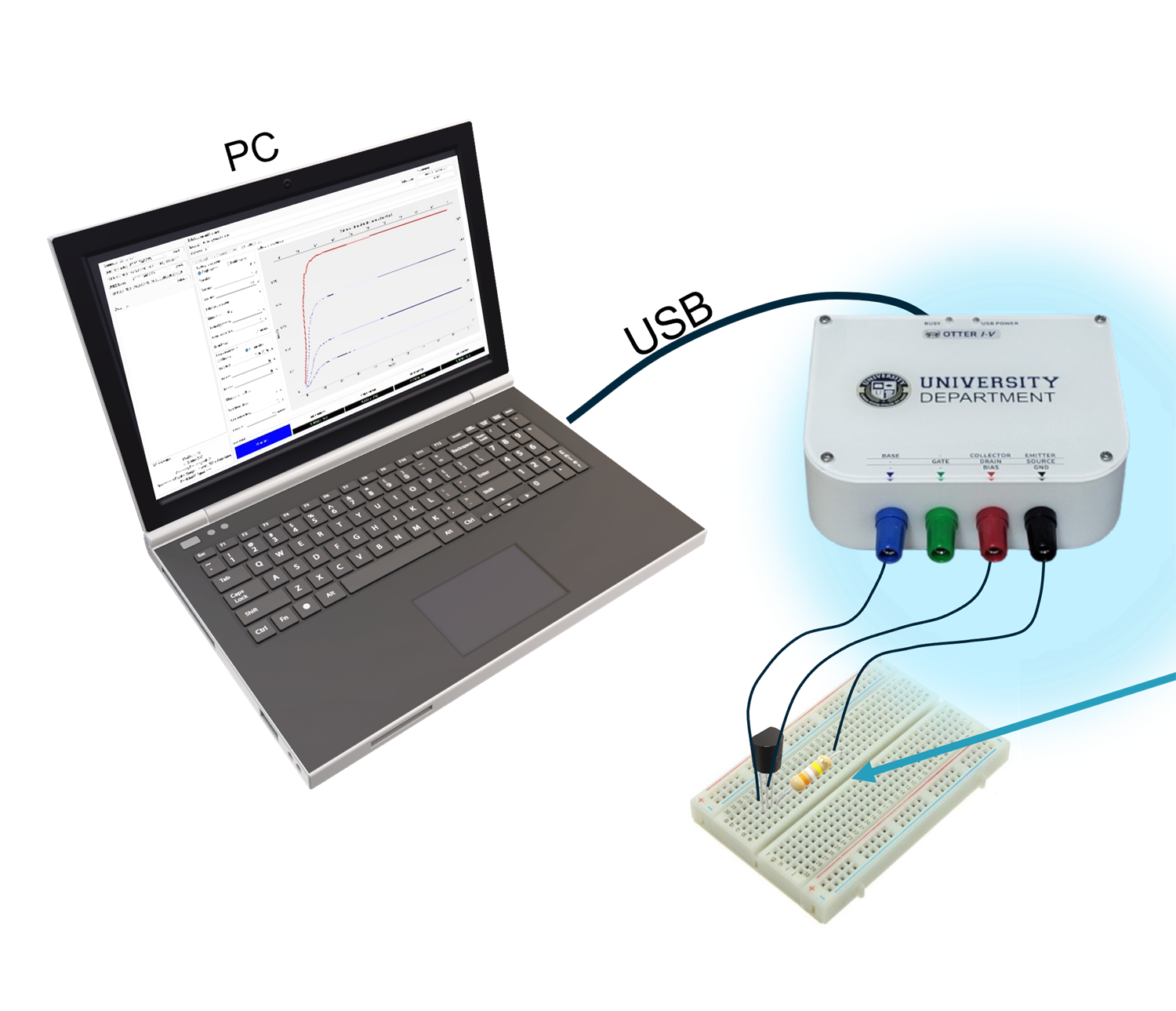
Connect the instrument to a laptop over USB and plug the device under test into the breadboard. Set the sweep conditions in the bundled software, press run, and the curve is plotted as it is measured.
- Off-the-shelf components mount on a breadboard, so preparation is minimal.
- Results are written to csv and open directly in a spreadsheet.
- Banana-to-jumper cables and a set of test devices are included.
Side by side
| Property | Otter I-V | Otter I-V Expert |
|---|---|---|
| Intended use | Undergraduate teaching | Research, device characterisation |
| Channels | Single configuration | 2 |
| Voltage range | −10 V to +10 V | ±80 V per channel |
| Current measurement | −8 mA to +8 mA | ±10 mA max, 4 ranges + AUTO |
| Current sourcing | 0 to 200 µA (BJT base) | Compliance settable up to 25 mA |
| Connectors | 4 mm banana | BNC |
| Control | Bundled Windows application | Bundled Windows application |
| Built-in routines | I-V, FET Output, FET Transfer, BJT Collector, I-t | The above plus EPSC / PPF, Endurance, Retention, P&D |
| Power | USB bus powered | USB-PD, 45 W or higher recommended |
| Software | Bundled application for Windows 10 and 11. Data saved as csv. Otter I-V also serves its own browser client over Wi-Fi, so an iPad or Android tablet needs no installation. | |
Documentation and demonstrations
Product documentation is currently published in Korean. Please contact us for an English datasheet or quotation.
Started in a lecture hall
Semi Otter Edu was founded by Hongseok Oh, assistant professor of physics at Soongsil University, as a faculty start-up.
Diodes and transistors underpin every semiconductor device, and textbooks describe their characteristics at length. Measuring those characteristics properly in an undergraduate lab, however, remained difficult: instruments designed for research are expensive, and a single unit serves only one group at a time. Teaching does not require the precision or the feature set of a research parameter analyser. Building only what the lab actually needs is what made this company.
- Korean patent no. 10-2831061
- Money Today 2026 Leading Company Awards — Start-up Award
- Faculty start-up, Soongsil University
Considering the instrument for your lab?
Tell us the quantity you need, your delivery timeline and how you plan to run the course, and we will prepare a quotation. We are happy to arrange a demonstration.